Musical keys for DJs
What a key is, major and minor, the 24 keys, the Camelot wheel and why some tracks clash while others blend beautifully. No sheet music required.
What a key is
A key is the group of notes a piece of music is built from, centered on one home note called the tonic. A song in A minor feels "at home" on the note A, and most of its melodies and chords use the notes of the A minor scale.
When two tracks in clashing keys play at the same time, their notes rub against each other and sound sour. When their keys are compatible, they blend smoothly. That is the basis of harmonic mixing.
Notes and semitones
Western music uses 12 different notes, repeating in higher and lower octaves:
C, C#/Db, D, D#/Eb, E, F, F#/Gb, G, G#/Ab, A, A#/Bb, B
The distance between neighboring notes is a semitone. Each of the 12 notes can be the home of a major key and a minor key, giving 24 keys in total.
Major and minor
| Major | Minor | |
|---|---|---|
| Common feeling | Bright, happy, uplifting | Darker, moodier, emotional |
| Example | C major (all white keys on a piano, starting on C) | A minor (all white keys, starting on A) |
| In dance music | Common in disco, pop and some house | Very common in techno, deep house and drum and bass |
Each major key has a relative minor that shares exactly the same notes. C major and A minor are relatives, so they usually mix well.
The Camelot wheel
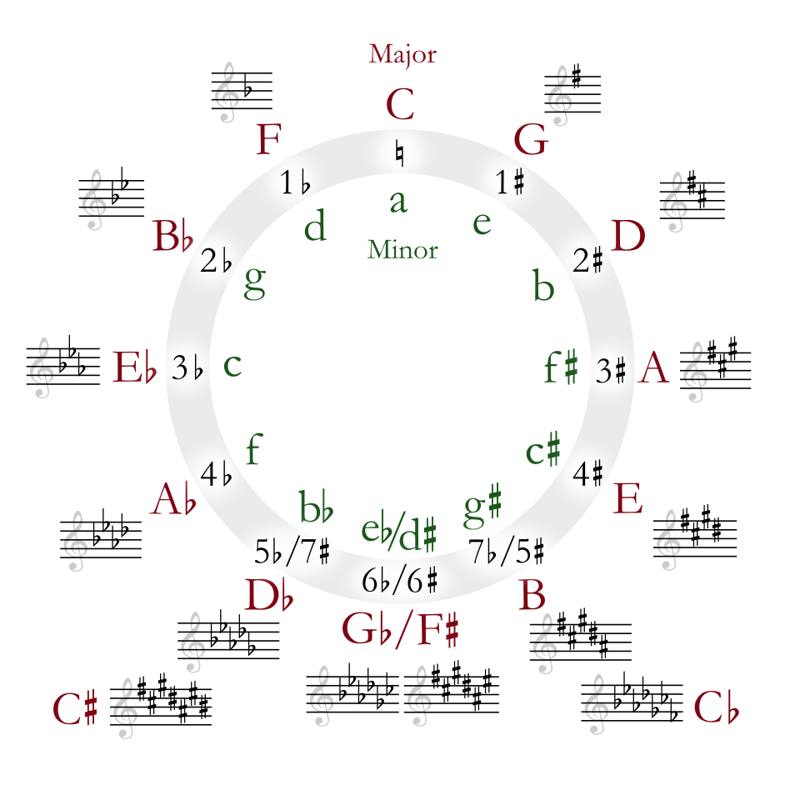
Most DJs do not think in note names. Instead, they use the Camelot wheel, a system popularized by the software Mixed In Key. It arranges the 24 keys like a clock:
- Numbers 1 to 12 go around the wheel.
- A means minor, B means major.
- For example, 8A is A minor and 8B is C major.
Keys next to each other on the wheel are closely related, because the wheel is based on the circle of fifths, where each step shares all but one note with its neighbor.
Compatible moves on the wheel
| Move | Example | Result |
|---|---|---|
| Same code | 8A to 8A | Perfect match |
| One step around | 8A to 7A or 9A | Smooth, closely related |
| Switch letter | 8A to 8B | Relative major or minor, mood change |
| Two steps around | 8A to 10A | Energy lift, some tension |
| Random jump | 8A to 3B | Likely clash |
Other systems exist. Traktor, for example, uses Open Key notation with numbers plus "m" for minor and "d" for major. Whichever system your software uses, the idea is the same.
How software finds the key
DJ software analyzes the audio and guesses the key. It is right most of the time, but not always, especially with tracks that change key, have few melodic parts or are mostly drums. Always trust your ears over the label.
Keys and pitch changes
When you speed up a track without key lock, its key rises too. A change of about 6% moves the key by one semitone, which can turn a perfect match into a clash. See pitch and key.
When keys matter less
- Drum-heavy sections such as intros and outros barely clash.
- Quick cuts leave no time for clashing.
- Percussive genres like some techno and drum and bass are more forgiving.
Keys matter most when two melodies, basslines or vocals overlap for a long time.
Hum the root note of the outgoing track during a blend. If the incoming track makes your hum sound wrong, the keys probably clash.